

News center
Home· · ·News Center· · ·News Center
News Center
How To – Qualify “A Good Balance” – Chapter 2
Time:2026-08-11
In the previous chapter, we discussed the USP general chapter requirements for accuracy and minimum weight. In this chapter, let us dive deeper into the specific requirements for repeatability and safety factors under USP.
Repeatability Requirements
USP General Chapter <41> states: “Repeatability is assessed by weighing one test weight not less than 10 times. Repeatability is satisfactory if two times the standard deviation of the weighed values, divided by the desired smallest net weight (i.e., the smallest net weight the user intends to use on the balance), does not exceed 0.10%.”
This requirement defines both the acceptance criteria a balance must meet and the specific test method to be applied. To fully understand this, we must first familiarize ourselves with the specific rounding rules applicable across all USP chapters. Let us begin with an example to make this rule easier to grasp:
- If the given acceptable repeatability requirement is ≤0.10%, a standard deviation of 0.1049% rounds to 0.10%. If this value is achieved, the balance passes the repeatability test.
- If the standard deviation is 0.1050%, it rounds to 0.11%, and the balance fails the repeatability test.
Finally, the USP-specific rounding rules can be summarized as follows:
Observed or calculated values shall be rounded to match the number of decimal places consistent with the limit expression (e.g., 0.10%). No rounding shall be performed until the final calculation yielding the reportable value is complete. When rounding is required, only the single digit immediately to the right of the last decimal place in the limit expression is considered. If that digit is less than 5, it is discarded and the preceding digit is retained. If that digit is equal to or greater than 5, the preceding digit is incremented by one.
Note: This rounding procedure differs significantly from rounding conventions used in all other fields and in legal metrology, where the format of any given limit value has no influence whatsoever on the rounding of measurement results.
Safety Factor
We know that in actual daily use, balance performance is influenced by numerous factors — environmental changes, special sample types, operator variability, differences in tare containers, etc. — and will also experience inevitable mechanical wear over long-term use, leading to measurement errors.
To minimize the impact of the above factors as much as possible, we employ two methods as a dual safeguard:
The first method is “Performance Verification”: USP General Chapter <1251> recommends that users test their balances regularly to ensure the balance consistently meets the specified requirements — this is known as “performance verification” (which we will cover in detail in the next chapter). The parameters verified include repeatability, which is particularly sensitive to the aforementioned factors, especially when users are weighing small quantities on analytical or semi-micro/micro balances.
The second method is applying a “Safety Factor”: In addition to routine user testing, any type of measuring instrument can adopt what is known as a safety factor. For balances, the application of a safety factor means that an authorized technician or user, under the prevailing environmental conditions at that time, weighs a mass that is just slightly greater than the minimum weight determined at that specific point in time.
Since the minimum weight is calculated from repeatability, and repeatability is particularly sensitive to environmental changes and operator technique, the minimum weight will fluctuate over time.
By setting the minimum net weight at a value higher than the minimum weight determined at a specific point in time under typical environmental conditions, the instrument can be assured to be “fit for purpose” regardless of variations in instrument performance. In other words, the minimum net weight that the user intends to weigh during normal balance use should be greater than the minimum weight determined at any given point in time.
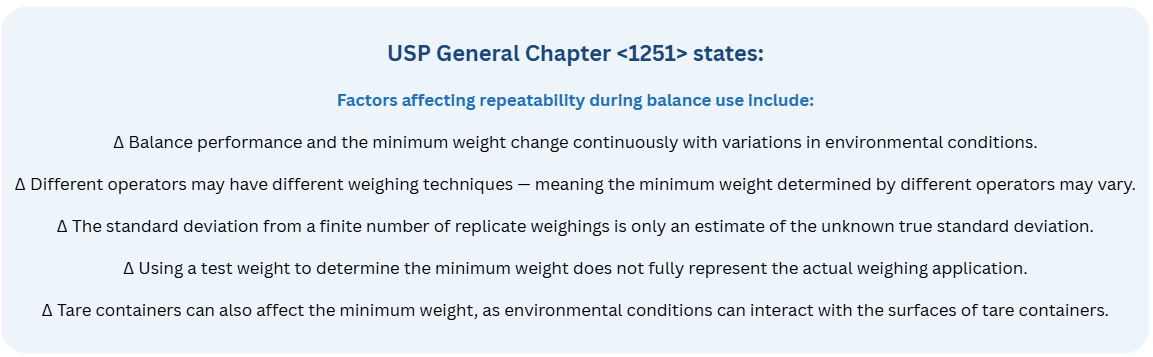
For these reasons, the mass to be weighed should, wherever possible, be greater than the minimum weight. In other words: “The target minimum net weight that the user intends to use on the balance should be greater than the minimum weight.”
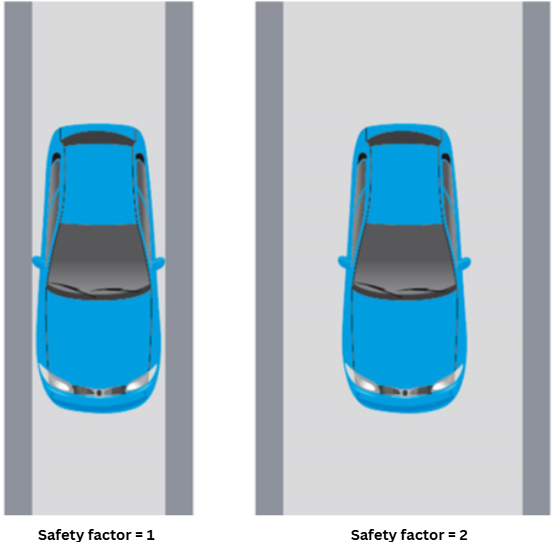
This concept can be quantified using a safety factor. For applications under USP General Chapter <41>, where the minimum weight is derived from the standard deviation, the safety factor is the quotient of the minimum net weight divided by the minimum weight.
For example:
- If a user wishes to weigh 28 mg on a semi-micro balance (i.e., minimum net weight = 28 mg), and the minimum weight has been determined to be 14 mg, the safety factor at this point is 2.
- Conversely, if the minimum weight of a balance at a given point in time has been determined to be 14 mg, and we apply a safety factor of 2, then this balance should be used to weigh samples of 28 mg or more to ensure reliable weighing.
How should we determine the own safety factor?
We recommend a safety factor of 2 for well-controlled laboratory environments. For more complex environments (e.g., production workshops), a safety factor of 3 or even 4 can generally be used. By extension, the more complex and unstable the weighing environment, the larger the safety factor that should be adopted.
How can Precisa assis with the Repeatability
At Precisa, our Series 390, Series 360, and Series 520 balances are equipped with an automated repeatability test designed to support efficient daily QC verification. This function helps reduce operator-to-operator variability by standardizing the repeatability assessment process. In addition, the system supports users in confirming that their balance performance is aligned with the requirements of USP General Chapter <41>, helping ensure accurate and reliable weighing—particularly for applications involving small net weights.
Get in Touch
We hope you have found this article about the Repeatibility and Safety Factor informative. If you would like assistance with conforming to the guidelines or to find out more information, please do not hesitate to get in touch with a member of our team today.
See you in the next chapter!
Related reading
- 2026-08-11How To – Qualify “A Good Balance” – Chapter 2
- 2026-08-04How To – Qualify “A Good Balance” – Chapter 1
- 2026-05-29Techcomp Thailand was excited to participate in TSEN 2026!
- 2025-12-22Measurement of Time-Resolved Photoluminescence in the Microsecond Range
- 2025-11-10Welcoming Partners at the Techcomp Thailand



 47/356 Kaitak Building 10 Fl., Room No. K100702-703, Popular Rd.,Banmai, Pakkret, Nonthaburi 11120, Thailand
 +66-2-117 9465-66
 +66-2-117 9467
 thsalesquote@techcomp.co.th
 @thk7892f
 +66-2-117 9465-66


 Top
Top